
Boolean Search for Recruitment, Sourcing & Lead Generation

- Description
- FAQ
- Notice
- Reviews
- Grade
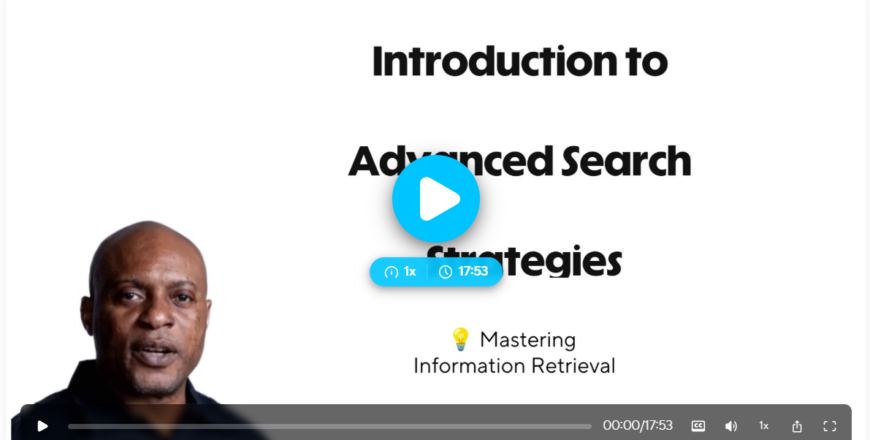
In an era of information overload, the ability to find high-quality, specific data quickly is a competitive advantage. Introduction to Advanced Search Strategies provides a deep dive into the technical and cognitive frameworks required for precision searching.
Students will move past the “single search box” mentality to explore Boolean logic, syntactic operators, and database-specific protocols. The course covers high-level techniques such as citation mining, proximity searching, and the use of “Search Command” syntax in major search engines (Google, Bing) and academic repositories (JSTOR, PubMed). By the end of this course, you will be able to construct complex search strings that filter out the “noise” and surface the most relevant, authoritative data for any project.
To Our Professional Community,
In the corporate world, time spent searching is time lost. We are proud to announce the launch of our new e-learning certification: Advanced Search Strategies for Professionals. This is not an academic research course; it is a productivity-focused masterclass designed for analysts, investigators, managers, and consultants who need to find specific, actionable data under tight deadlines. Whether you are conducting competitive intelligence, performing due diligence, or sourcing technical documentation, this course will drastically reduce your "time-to-insight."
Program Overview
-
Delivery Format: 100% Online & Self-Paced. Designed to fit into a busy work schedule.
-
Access: Modules are available 24/7 via the Professional Learning Portal.
-
Duration: Approximately 4 hours of core content, plus optional "Pro-Labs" for specialized industries.
-
Focus: Precision-engineered search strings, hidden filter syntax, and verifying source authority.
Key Professional Outcomes
-
Efficiency: Cut your research time by up to 50% using advanced command syntax.
-
Breadth: Move beyond Google to leverage specialized business directories and public records.
-
Verification: Learn professional-grade techniques for fact-checking and source validation to protect your organization from misinformation.
How to Begin
-
Current Learners: Log in to your dashboard; the course has been added to your "Available Skills" catalog.
-
New Visitors: Click the "Request Access" button below to view the introductory module and course roadmap.
-
Technical Support: For login issues or platform navigation, please contact the IT Learning Desk.
Note: This course includes a "Search Efficiency Audit"—a final assessment that compares your pre-course and post-course search speeds to quantify your ROI.
Elevate your information game today.
Core Learning Modules
-
The Logic of Search: Understanding Boolean Operators (AND, OR, NOT) and their mathematical relationship to result sets.
-
Precision Syntax: Master truncation (*), wildcards (?), and phrase searching ("") to capture variations in language.
-
Search Engine Command Center: Utilizing advanced Google/Bing operators like
site:,filetype:,intitle:, andrelated:. -
Database Navigation: Learning the difference between "natural language" and "controlled vocabulary" (Subject Headings/Descriptors).
-
The "Breadcrumb" Strategy: Forward and backward citation mining to trace the evolution of an idea or research topic.
To succeed in this course, participants should meet the following criteria:
-
Prerequisites: * Basic computer literacy and comfort with web browsers (Chrome, Firefox, or Safari).
-
Experience using standard search engines for daily tasks.
-
-
Technical Requirements: * A laptop or desktop with high-speed internet.
-
Access to a library database (optional, but highly recommended for the academic modules).
-
-
Cognitive Requirements: * A "curiosity-first" mindset and the patience to engage in iterative trial-and-error.
-
Basic analytical skills to evaluate the credibility of found sources.
-
This course is designed for individuals who rely on pinpoint accuracy and high-speed information retrieval to drive their work, including:
-
Talent Acquisition & Executive Recruiters: Professionals looking to identify "hidden" candidates, uncover niche portfolios, and scrape public data for specialized talent leads.
-
Sales & Business Development Professionals: High-performers who need to find decision-maker contact info, deep-dive into prospect pain points, and locate internal company PDFs or organizational charts.
-
Market Analysts & Business Intelligence Professionals: Anyone needing to extract niche industry reports, competitor data, or specific whitepapers to gain a strategic edge.
-
Academic Researchers & Students: Those conducting deep literature reviews, preparing dissertations, or managing complex capstone projects.
-
Content Creators & Journalists: Media professionals who must fact-check sources, find original primary documents, and verify statistical data.
-
Information Professionals: Aspiring librarians, archivists, or SEO specialists looking to master advanced technical discovery skills.
Beyond researchers, recruiters, and sales teams, several other high-stakes professions rely on "forensic-grade" search skills to manage risk and verify truth.
Here are the additional groups that would find this course essential:
Legal & Compliance Professionals
-
Lawyers & Paralegals: For deep-dive case law research, asset tracing, and locating obscure public records or court filings.
-
<!-->Due Diligence & Anti-Money Laundering (AML) Officers: For vetting third-party partners and identifying potential "red flags" or PEPs (Politically Exposed Persons) hidden in the deep web.-->
Trust, Safety & Risk Intelligence
-
Fraud Investigators: For tracking digital footprints and identifying patterns of fraudulent activity or brand impersonation across the web.
Cybersecurity Analysts: For "Threat Hunting"—using advanced search (like Google Dorking) to find exposed credentials, leaked data, or vulnerabilities before they are exploited.
Corporate & Strategic Leadership
-
Competitive Intelligence Managers: For monitoring competitor pricing, identifying upcoming patent filings, or finding internal PDFs and strategy documents accidentally left indexed.
-
Project Managers & Business Analysts: For gathering the raw data needed to validate project feasibility and assessing market risks in real-time.
Government & Private Investigation
-
Private Investigators & OSINT Practitioners: For using "Open Source Intelligence" techniques to locate individuals, verify backgrounds, or conduct geospatial research.
-
Law Enforcement: For gathering evidence from public digital sources and monitoring emerging social trends or public safety risks.

-
7
 The Parentheses (...)
 -
8
Asterisk or Wildcard Operator
-
9
X-ray Search Syntax Operators
X-ray search operators act as "dials" to pinpoint exactly where and how to look for keywords or file types within a specific domain or URL structure, revealing indexed content not easily found otherwise.
-
10
The proximity (NEAR)
-
11
The AROUND(n) Proximity Operator
-
12
 Sourcing Scenarios
Here are three advanced sourcing scenarios using specific field commands


 Google
  Facebook